
Dorfromantik Tips & Guide: Essential Strategies for Tile Placement, Quest Completion, and Building High-Scoring Landscapes
Dorfromantik is a relaxing strategy and puzzle game built around placing hexagonal landscape tiles to create a growing countryside. You connect forests, villages, fields, rivers, and railway lines, gradually transforming a collection of individual pieces into a beautiful and interconnected landscape. Its peaceful atmosphere makes it easy to enjoy casually, but achieving a high score requires careful planning and an understanding of how tiles connect.
Unlike traditional city-building games, Dorfromantik does not ask you to manage money, construct buildings, or maintain a population. Instead, the challenge comes from making the best use of a limited supply of tiles. Every placement changes the shape of your landscape and can influence future opportunities. A seemingly harmless decision can create an awkward gap, while a carefully planned connection can help complete a large area and earn valuable points.
The game combines spatial reasoning, resource management, and long-term planning. You must balance immediate objectives with the possibility of creating larger connected regions. Completing quests provides additional tiles, extending your run and allowing your landscape to grow. However, chasing every objective without considering the surrounding terrain can leave you with difficult placements later.
This guide covers ten essential areas, from understanding the basic tile-placement system to managing quests, building large regions, and improving your high-score strategy.
1. Understand the Core Gameplay and Tile Placement System
Dorfromantik is based on placing hexagonal tiles next to one another. Each tile contains one or more landscape types, and the objective is to create connections that make sense according to the terrain shown on neighboring edges.
The main landscape types include forests, villages, fields, water, and railway or other transport features. Some tiles contain a single landscape type, while others combine multiple environments. This variety creates interesting placement opportunities and makes every landscape slightly different.
Learn how matching edges work
When placing a tile, examine the landscape along each of its six edges. Matching terrain generally creates a cleaner connection and helps you build larger continuous areas.
For example, connecting forest edges to other forest edges can help develop an extensive woodland region. Similarly, matching water or railway sections can maintain the continuity of those features.
Before confirming a placement, consider:
- Which edges will match the surrounding tiles?
- Will the new tile extend an existing region?
- Could it create an awkward boundary?
- Does it help complete a nearby quest?
- Will it leave useful space for future tiles?
Think beyond the immediate placement
A tile may fit perfectly in one position but create problems for the surrounding landscape. Always examine the neighboring spaces before placing it.
The best placement is not necessarily the one that produces the most matching edges immediately. It is the one that improves your current layout while preserving flexibility for future decisions.
2. Learn the Different Landscape Types and Their Characteristics
Understanding landscape types is essential because each one creates different opportunities for expansion and scoring. Some are relatively easy to connect, while others can become difficult when their boundaries are surrounded by incompatible terrain.
Forests, fields, villages, rivers, and railways should not all be approached in exactly the same way. Their shapes and placement requirements influence how you should develop the surrounding landscape.
Build large, continuous regions
One useful strategy is to identify opportunities for expanding a large region before it becomes surrounded by other terrain types.
For example, if you want to create a large forest, look for positions that allow additional forest edges to remain accessible. Placing unrelated terrain around the area too early can make future expansion difficult.
Watch mixed-terrain tiles
Tiles containing several landscape types are particularly important because they can connect different parts of your landscape.
A mixed tile might help link two regions that would otherwise remain separate. However, it can also introduce several boundaries that restrict later placements.
Use these tiles carefully:
- Examine every edge before choosing a position.
- Look for opportunities to connect existing regions.
- Avoid placing mixed tiles where they block valuable expansion areas.
- Consider whether they help complete a nearby objective.
- Preserve alternative positions when the tile has several possible uses.
Learning how each landscape type behaves will make placement decisions much more predictable.

3. Prioritize Quests to Extend Your Tile Supply
Quests are one of the most important progression systems in Dorfromantik. They provide objectives related to particular landscape features, such as creating or expanding a specific type of region.
Completing quests can reward additional tiles, which allows your landscape to continue growing. Because your tile supply is limited, quests are more than optional challenges. They are a major part of sustaining a successful run.
Understand the value of quest completion
A quest may appear small, but completing several objectives can significantly extend your available tile supply.
When a quest appears, evaluate how difficult it will be to complete using your current landscape. Some objectives may already be close to completion, while others require extensive planning.
Prioritize quests that:
- Can be completed with relatively few additional placements.
- Fit naturally into an existing region.
- Support your broader landscape plan.
- Do not require sacrificing several useful placement opportunities.
- Provide a realistic path to earning additional tiles.
Avoid chasing every quest blindly
Not every objective deserves immediate attention. Trying to complete multiple difficult quests simultaneously can lead to poor placements and fragmented terrain.
Focus on objectives that fit the landscape you are already developing. If a quest requires an awkward placement, consider whether waiting for a more suitable tile would produce a better result.
The goal is to complete quests efficiently without damaging the overall structure of your map.
4. Plan Your Landscape Before Placing Difficult Tiles
One of the biggest differences between casual and high-scoring play is the amount of planning involved. Beginners often place tiles wherever they appear to fit, while experienced players consider how each placement affects future options.
Because the landscape expands outward, every tile influences the available positions around it. A poor placement can create narrow gaps, isolated regions, or boundaries that are difficult to match.
Identify natural expansion zones
Look for areas where a particular landscape type can grow without being blocked by unrelated terrain.
If a large forest occupies one side of your map, you may want to preserve open positions around its boundary. The same principle applies to large fields, villages, and water systems.
Avoid surrounding a developing region with incompatible terrain unless you have a clear reason for doing so.
Keep several future placements possible
A strong layout should offer multiple reasonable positions for different types of tiles.
This is particularly important when your next tile contains an unusual combination of landscapes. If the map has only one suitable location for each terrain type, your placement choices become extremely restrictive.
A useful habit is to inspect the available spaces around your landscape before confirming a tile. Ask whether the placement creates more opportunities or closes too many of them.
5. Build Large Regions for Better Scoring Opportunities
Creating large connected landscape regions is one of the most rewarding aspects of Dorfromantik. Large forests, fields, and other terrain groups can become major features of your map and provide opportunities to pursue higher scores.
However, size alone is not the only consideration. The shape of a region and the number of matching edges also matter.
Expand regions strategically
When developing a large region, look for placements that extend its boundaries without introducing unnecessary fragmentation.
For instance, adding a forest tile to an existing forest area can be useful when several of its edges match. A tile with only one matching edge may still be appropriate if it helps preserve a larger expansion route.
Avoid creating disconnected fragments
Small isolated regions can be difficult to develop because they have fewer neighboring spaces and may require specific tiles to expand.
Before creating a new region, consider whether it would be more beneficial to connect it to an existing one.
This does not mean every landscape type must form one enormous region. Sometimes separate clusters are useful for quests or for accommodating mixed-terrain tiles. The important point is to avoid creating isolated areas without a clear purpose.
Balance size with flexibility
A huge region can become difficult to manage if its boundaries are surrounded by incompatible terrain. Continue to preserve useful spaces around large areas so that they can grow naturally.
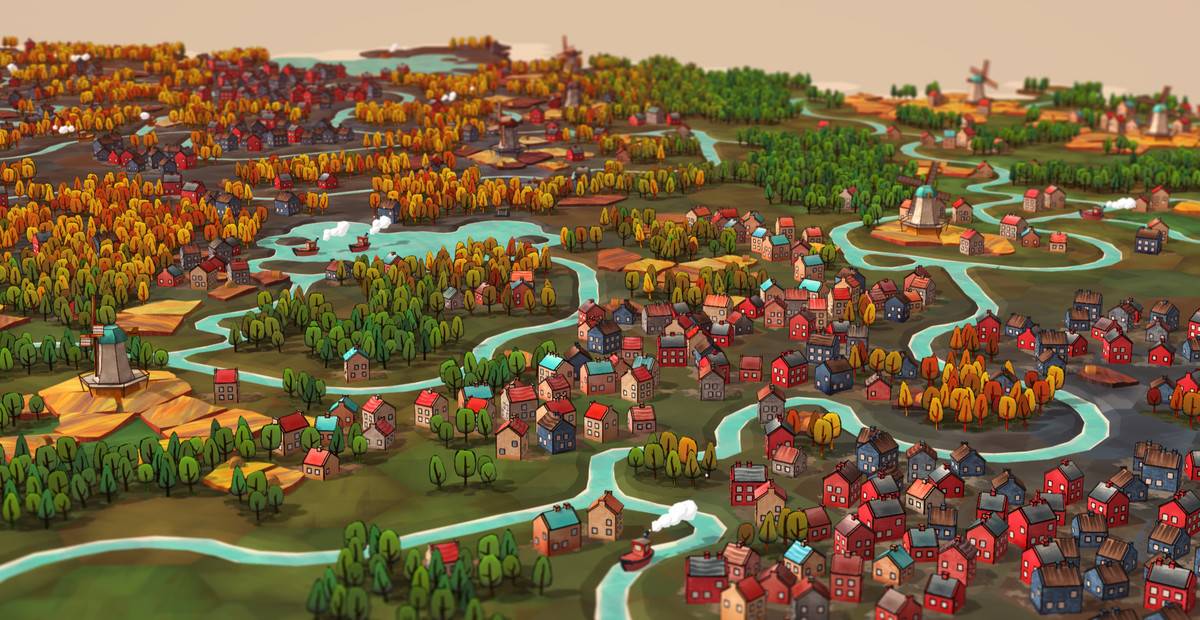
6. Manage Rivers and Railways Without Blocking Your Map
Rivers and railway lines introduce additional spatial challenges because their connections are more directional than ordinary landscape matching.
A river that reaches an awkward position can become difficult to extend, while railway sections may require careful alignment to maintain continuity. These features can also influence where other terrain types can be placed.
Follow the natural direction of connections
When placing a river or railway tile, examine the direction of its connecting edges. Consider where the feature could continue and whether nearby tiles leave enough room for expansion.
Avoid making a placement simply because one edge matches. Check the entire route and think about what the next tile might need to look like.
Prevent unnecessary dead ends
Dead ends are not always harmful, but they can become problematic when they occur in locations where you intended to create a continuous route.
Before extending a river or railway, consider:
- Whether the connection can continue in a useful direction.
- Whether nearby terrain leaves enough room for future tiles.
- Whether the route is likely to interfere with another region.
- Whether a different position would provide more flexibility.
Use difficult tiles to solve existing problems
Some placements become easier when you treat rivers and railways as part of the broader landscape rather than separate projects.
A tile that connects a transport feature while also matching nearby terrain can be especially valuable. Look for opportunities where one placement solves several layout problems at once.
7. Improve Tile Efficiency and Avoid Wasteful Placements
Every tile represents an opportunity to improve the landscape. Because the available supply is limited, wasteful placements can shorten a run and reduce your chances of reaching a high score.
Efficiency does not mean every tile must produce a perfect result. Sometimes a less-than-ideal placement is necessary to keep the landscape open or complete an important quest.
The key is understanding what you gain and what you sacrifice.
Compare placement options
When a tile has several possible positions, do not automatically choose the first one that looks acceptable.
Compare the options based on:
- Number of matching edges.
- Opportunities to expand existing regions.
- Potential quest progress.
- Effect on rivers and railway connections.
- Space preserved for future placements.
A tile that matches fewer edges may still be better if it creates a useful connection or keeps a large area open.
Avoid unnecessary isolated placements
Placing a tile far from your main development area can create an awkward shape or force future tiles into inconvenient positions.
Before extending the map in a new direction, consider whether the expansion has a purpose. If it does not help with quests, regional growth, or future placement flexibility, another position may be more useful.
Accept imperfect decisions when necessary
There will be situations where no placement is ideal. Rather than spending too much time searching for a perfect solution, choose the option that creates the fewest long-term problems.
Good strategy is about managing trade-offs, not eliminating them entirely.

8. Use Challenges and Different Game Modes to Improve Your Skills
Dorfromantik offers more than one way to enjoy its tile-placement system. Different modes and challenges can provide opportunities to experiment with strategies, understand scoring, and improve your decision-making.
If you are new to the game, begin with a comfortable approach and learn how the landscape behaves. Once you understand the basics, challenges can help you focus on specific skills.
Practice with different strategic goals
Instead of trying to maximize every aspect of the map at once, experiment with individual objectives.
For example, one run can focus on developing large forests, while another can emphasize river connections or quest completion. This helps you understand how different placement decisions influence the overall result.
Learn from unsuccessful runs
A run that ends earlier than expected can still provide useful information.
Review the areas where the landscape became difficult to expand. Did you close too many spaces around a large region? Did you create too many disconnected areas? Were quests ignored until they became difficult to complete?
Identifying these patterns makes future runs more consistent.
Experiment without worrying about perfect scores
The relaxing atmosphere is part of the game's appeal. Do not turn every session into a competition against your previous result.
Trying unusual layouts can reveal creative solutions that improve your understanding of the placement system.
9. Avoid Common Beginner Mistakes
Many early mistakes come from treating Dorfromantik as a simple matching puzzle rather than a long-term spatial planning game.
A tile may fit locally while creating problems for the rest of the map. Understanding these common mistakes will help you make more reliable decisions.
Placing tiles without considering future space
This is one of the most important mistakes to avoid. Closing the boundaries of a large region too early can prevent it from expanding.
Always consider what types of tiles might be useful around a developing area before surrounding it.
Ignoring quests until the map becomes difficult
Quests help maintain your tile supply. Ignoring them for too long can reduce your available opportunities and make recovery harder.
You do not need to pursue every objective immediately, but you should keep track of realistic opportunities to complete them.
Overcommitting to one landscape type
Building a large forest or field can be satisfying, but focusing exclusively on one region may create problems elsewhere.
Maintain enough flexibility to accommodate mixed tiles and different quest requirements.
Expanding too quickly
A larger map is not automatically a better map. Every new section creates additional boundaries that must be managed.
Expand when the new area serves a purpose rather than simply because an available tile can be placed there.
10. Advanced Strategies for High Scores and Long-Term Landscape Planning
Once you understand the basics, improving your score becomes a matter of combining quest management, region development, and efficient placement.
Advanced play requires thinking several moves ahead. Instead of evaluating only the tile currently in your hand, consider the shape of the map, the terrain surrounding important regions, and the possibilities created by different placements.
Evaluate each placement from multiple perspectives
A strong placement often provides several benefits at once. It might extend a large forest, improve a quest, and preserve open spaces for future tiles.
When choosing between positions, evaluate the overall impact rather than focusing on one scoring opportunity.
A useful decision process is:
- Identify the most important current quest.
- Examine the available placement positions.
- Compare the matching edges and regional connections.
- Consider how the placement affects nearby expansion space.
- Choose the option that supports both immediate progress and future flexibility.
Maintain a balanced landscape
A balanced map contains opportunities for different terrain types rather than relying entirely on one large region.
This makes it easier to accommodate mixed tiles and adapt to changing quest requirements.
Try to avoid creating too many isolated pockets, but do not force every landscape type into one continuous area when the available tiles make that impractical.
Treat flexibility as a valuable resource
In the later stages of a run, a flexible map can be more useful than one with impressive but restrictive regions.
Open spaces around important boundaries allow you to respond to unexpected tiles. Keeping those options available gives you more control over the landscape as the tile supply becomes increasingly important.
Ultimately, the strongest high-score strategy is to combine careful planning with the ability to adapt when the next tile does not match your expectations.
Conclusion
Dorfromantik is a relaxing yet thoughtful strategy game that rewards patience, spatial awareness, and long-term planning. Its simple tile-placement mechanics create surprisingly complex decisions as your landscape grows and the available space becomes more valuable.
Start by understanding terrain connections, learning how quests extend your tile supply, and developing large regions without blocking their future expansion. Pay special attention to rivers and railways, compare placement options carefully, and avoid creating unnecessary isolated areas.
As you improve, focus on balancing immediate scoring opportunities with the flexibility needed for future tiles. A successful landscape is not simply the largest one, but one that makes effective use of every placement while remaining open to new possibilities.
Description (160 characters): Master Dorfromantik with tips for smart tile placement, quest completion, landscape expansion, river connections, and high-scoring countryside designs.